Keysight D9010MCDP/R-B5P-001-A/R-B6P-001-L, MIPI CSI and DSI Protocol Decode/Trigger Software (C-PHY and D-PHY),
Node-locked perpetual license with 12 months KeysightCare software support
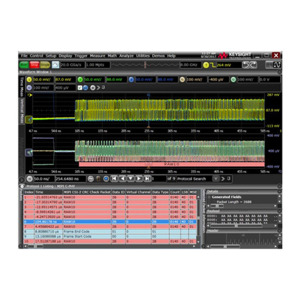
The S-Series Protocol Applications from Keysight allows you to simplify the debugging of your design with more than 19 protocol decoders available, and quickly move between physical and protocol layer information using the time-correlated tracking marker.
Key Features & Specifications
MIPI C-PHY and D-PHY Multilane Trigger and Protocol Decode
Description
MIPI D-PHY Multilane Trigger and Protocol Decode
Emerging serial bus standards in the wireless mobile industry have created the need for team to debug and test MIPI D-PHY. The MIPI D-PHY protocol application enables faster and better development of wireless mobile products employing CSI and DSI architectures of the MIPI technology. The protocol analysis application enables teams to quickly move from physical layer to protocol layer measurements and includes software-based triggering.
ISI Channels
These ISI Channels can be used to emulate channel loses in receiver test setups. A choice of 8 PC board traces with different lengths can be inserted into the signal path. The 8 trace lengths range from 7.7 inch (196 mm) to 34.4 inch (874 mm). By cascading the traces within one box or with the other box a wide range of channels can be emulated with very fine resolution steps. With their small size the ISI channels can be located closely to the device under test. The cascadable ISI channels are complemented by Keysight’s compliance channels for SATA, DisplayPort, PCI Express, and HDMI
MIPI C-PHY Trigger and Protocol Decode
C-PHY is a MIPI physical layer (PHY) standard that provides high-throughput performance over bandwidth-limited channels to connect displays and cameras to an application processor. The standard provides a PHY for both MIPI Alliance’s Camera Serial Interface (CSI-2) and Display Interface (DSI-2) specifications. This enables engineers to scale their implementations to support a wide range of higher resolution image sensors and displays, while keeping power consumption low. However, because the C-PHY supports two application layers, engineers implementing a C-PHY interface must be able to see a device’s signal integrity and protocol data to ensure it conforms to the MIPI specification.
With C-PHY, seven consecutive symbols are used to transmit 16 bits of data over a minimum of 3 wires (one lane), after encoding. Troubleshooting C-PHY-based applications can therefore, be time-consuming and error-prone because the engineer has to manually scroll through the waveform looking for regions of interest.
Keysight’s D9010MCDP software extends the capability of Infiniium oscilloscopes, minimizing the time required for debugging and testing designs with CSI-2 and DSI-2 interfaces.
Configurations:
This software helps you perform jitter, vertical, and phase noise analysis with Keysight’s Infiniium 9000, S-Series, EXR-Series, MXR-Series oscilloscopes.
Jitter Analysis:
Phase Noise Analysis:
Time correlation of jitter to the real-time signal helps you easily trace jitter components to their sources. Additional compliance views and a measurement setup wizard now simplify and automate RJ/DJ separation for testing against industry standards.
This software automatically detects embedded clock frequencies and repetitive patterns of the data on the oscilloscope inputs and calculates the level of data-dependent jitter (DDJ) that is contributed to the total jitter (TJ) PDF by each transition in the pattern. It also comes with both spectral and tail-fit jitter separation algorithm. Since every waveform is different, multiple jitter separation solutions give you better answers for each individual waveform. Use the new tail-fit algorithm to properly identify and measure aperiodic bounded uncorrelated jitter, which is especially useful if the waveform is being influenced by cross-talk.
The Phase Noise analysis feature measures phase noise in a clock source. Get measurement results presented in a log frequency plot where the amplitude units are listed in units of dBc/Hz (decibels relative to the carrier power normalized to a 1 Hz bandwidth).